

A water settlement under pressure
The Indus Waters Treaty was designed to make a shared river system workable between two States whose relations were already difficult. Partition had left irrigation infrastructure and the rivers supplying it divided between India and Pakistan. The settlement signed at Karachi on 19 September 1960, following negotiations assisted by the World Bank, allocated rights over the eastern and western rivers and created machinery for resolving disagreements. Its practical achievement was to replace recurring uncertainty about upstream control with specified rights, restrictions and procedures.[1]
On 23 April 2025, the day after the Pahalgam terrorist attack, India announced that the treaty would be held in “abeyance”. India linked restoration to Pakistan credibly and irrevocably renouncing support for cross-border terrorism. Pakistan rejected the announcement and denied that India could unilaterally displace the water settlement. Those are the States’ positions; responsibility for the attack must not be treated as an established finding of the water proceedings.[2]
The resulting questions are distinct. Can India lawfully suspend the treaty? Does its announcement stop proceedings already instituted under it? And, even if the treaty remains in force, might international law excuse some particular, temporary departure from its obligations?
The treaty gives India a right to generate hydropower on the western rivers within agreed limits. It also gives the Neutral Expert authority to decide specified technical questions about projects such as Ratle. Those provisions give India firm grounds to defend its projects and to question how parallel proceedings affect them. Suspending the treaty as a whole raises a separate legal question. On 31 August 2026, the Court of Arbitration held that the treaty remained in force. India maintains that the Court was improperly constituted. Even considered independently of the award, the legal case for treaty-wide suspension is difficult to sustain on the available record.[3]
At Ratle, on the Chenab, these apparently abstract distinctions become a construction problem: how much concrete can engineers pour before a disputed design becomes prohibitively difficult to change? Restrict construction too readily and an Indian project permitted in principle may suffer costly delay. Allow irreversible work and a successful Pakistani challenge may arrive too late to provide an effective remedy. That problem supplies a more useful starting point for the arbitration controversy than the language of either unrestricted sovereignty or an absolute downstream veto.
The bargain: protected flows and usable Indian rights
The treaty principally allocates rights over rivers rather than dividing a single annual volume by percentage. The eastern rivers—Ravi, Beas and Sutlej—are generally available for India’s unrestricted use, subject to the treaty. For the western rivers—Indus, Jhelum and Chenab—Article III establishes Pakistan’s entitlement and India’s duty to let the waters flow, alongside defined Indian uses. Hydropower is expressly permitted, subject to Annexure D; agriculture and storage have their own conditions in Annexures C and E.[1]
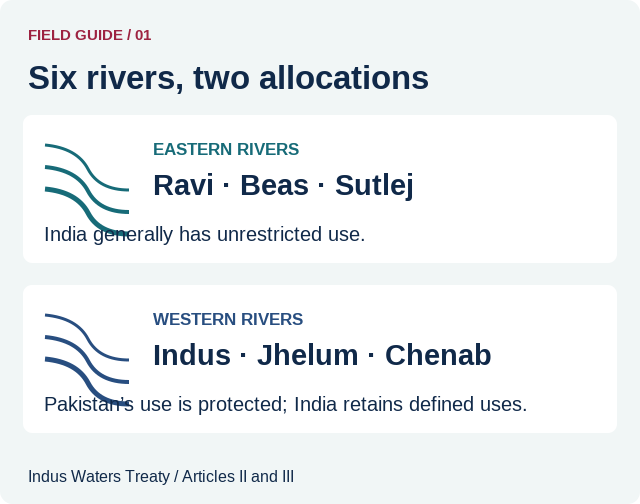 01 / The allocation at a glance
Ravi, Beas, Sutlej
Their waters are generally available for India’s unrestricted use, subject to the treaty’s express provisions.
Indus, Jhelum, Chenab
India must generally let these waters flow for Pakistan. It retains defined domestic, agricultural, non-consumptive and hydropower uses; storage is separately limited.
Neither State can sensibly interpret only the half of this arrangement that it prefers. Pakistan’s protected position cannot erase the Indian permissions. India’s permissions cannot erase the restrictions that helped secure Pakistan’s agreement. The central interpretive task is to give practical effect to both.
Three engineering terms help explain the disagreement. A run-of-river plant uses river flow without the large operational storage associated with a conventional storage project, although the treaty permits specified pondage and surcharge storage. Pondage is the limited operating storage used to meet fluctuations in power demand. Dead storage is the portion not used for operational purposes, below the corresponding dead storage level. The label does not mean that its treatment is legally unimportant: lowering a reservoir into that zone, then refilling it, can affect downstream flows.[1,4]
India’s practical case is substantial. A permission to generate electricity must accommodate a functioning plant, rather than an engineering abstraction. Sediment can impair reservoir capacity and equipment. Intake placement, flood discharge arrangements and operating storage need to be evaluated against conditions at the site. Where the text itself calls for judgments about necessity, economy or satisfactory operation, engineering evidence belongs inside the interpretation.
Pakistan’s answer is equally concrete. Restrictions on low-level outlets, spillways, intakes and pondage regulate the capacity to control water, not merely misconduct proved after a project begins operating. Requiring Pakistan to wait for a damaging interruption would diminish the protection supplied by design restrictions in the first place.
The stronger Indian argument is consequently not that modern engineering overrides Annexure D. It is that the discretion which Annexure D actually leaves must be usable. Conversely, Pakistan must identify the relevant restriction and establish its application; a concern about upstream power cannot itself prohibit every design choice.
How the present dispute developed
The current proceedings sit within a longer history. Earlier decisions explain both India’s confidence in expert determination and the limits of treating technical practice as the last word.
| Date | Development | Legal significance |
|---|---|---|
| 12 February 2007 | Raymond Lafitte’s Baglihar determination | A Neutral Expert applied treaty criteria to an identified project; its effect beyond that project remains crucial to understanding later disputes.[5] |
| 18 February and 20 December 2013 | Kishenganga Partial and Final Awards; clarification decision in December | Permitted a qualified Indian diversion for generation, addressed reservoir depletion and fixed a downstream minimum-flow regime.[6] |
| 19 August / 4 October 2016 | Pakistan instituted arbitration; India requested World Bank appointment of a Neutral Expert | The ordering and legal effect of these steps became central to competence.[7,8] |
| 12 December 2016 / 6 April 2022 | World Bank paused, then resumed, the appointment processes | The Bank acknowledged risks from concurrent proceedings; its appointments did not adjudicate treaty compliance.[9] |
| 6 July 2023 | Court’s competence award | Rejected India’s objections to the arbitration.[7] |
| 7 January 2025 | Neutral Expert’s competence decision, announced publicly on 20 January; corrected on 31 March | Accepted the referred design differences as within his mandate. This was not approval of the designs.[8] |
| 23–24 April / 27 June 2025 | India announced and communicated abeyance; Court issued supplemental competence award | The Court held that abeyance did not remove its competence, without deciding every substantive justification for non-performance.[2,10] |
| 8 August 2025 / 15 May 2026 | General-interpretation award; supplemental maximum-pondage award | Developed the legal framework applicable to western-river plants.[4,11] |
| 31 August 2026 | Treaty-status award and separate Ratle interim order | Rejected the asserted grounds for abeyance and restricted specified construction, while leaving other work possible.[3,12] |
Baglihar and Kishenganga: neither a blank cheque nor a blanket prohibition
Baglihar is important because Lafitte took sediment management and contemporary engineering seriously. His determination supported aspects of India’s design while requiring changes to others; it was not unconditional approval. His discussion of reservoir maintenance also explains India’s subsequent reliance on the decision.[5]
But a binding determination of a particular difference is not necessarily a binding general interpretation for every later dam. Annexure F paragraph 11 links finality to matters within the expert’s competence and to the particular matter decided. The distinction preserves Baglihar’s effect without converting every element of its reasoning into a transferable entitlement.
Kishenganga illustrates both sides of the bargain. The 2013 awards recognised India’s right to divert water between tributaries for generation under the applicable conditions. They also prohibited depletion below dead storage level for ordinary drawdown flushing—lowering the reservoir to remove accumulated sediment—while preserving the unforeseen-emergency exception and specified protection for existing or qualifying projects. The Final Award required a release of 9 cubic metres per second when daily average upstream inflow meets or exceeds that figure; below it, the full daily average inflow must pass downstream. It also provided a route to reconsider the minimum flow.[6]
For India, these decisions demonstrate that adjudication can vindicate a meaningful development right. For Pakistan, they demonstrate that such a right is constrained. A new design cannot avoid an applicable legal restriction simply by presenting better evidence that the prohibited technique is efficient. Engineering evidence remains essential to applying the permissions and selecting workable alternatives; it is not an amendment procedure.
Two mechanisms, and a genuine problem of overlap
Article IX begins with examination by the Permanent Indus Commission. Unresolved differences within the specified Annexure F categories may go to a Neutral Expert. Other disputes, including matters referred onwards under the treaty, may proceed through the governmental and arbitral stages. This is a branching system, not an automatic appeal ladder.[1,7,8]
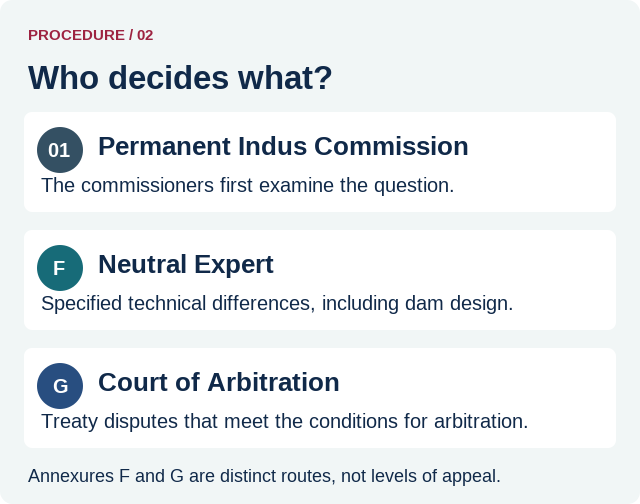 02 / Follow the question, not just the project
Does this design comply?
The Neutral Expert accepted competence in January 2025 over the seven technical points referred to him. That was a ruling on his mandate, not approval of the designs.
What does the treaty require?
The Court upheld its competence in July 2023. It later interpreted the hydropower rules, including maximum pondage. An interpretation can shape the engineer’s work without answering every design question.
The World Bank performs specified appointment functions. The PCA acts as secretariat or registry. Neither role makes the Bank the adjudicator of a dam’s legality or turns this interstate Court into an investor–State tribunal.
India’s objection deserves more than a dismissal as reluctance to arbitrate. Article IX(6) says that the governmental and arbitral provisions in paragraphs 3–5 do not apply to a difference while a Neutral Expert is dealing with it. Annexure F paragraph 11 makes a decision within the expert’s competence final and binding, in respect of the particular matter, on the States and any treaty Court of Arbitration.[1]
The functional concern follows directly. If a party can remove every difficult engineering question from the expert by calling it a question of interpretation, the specialist mechanism loses much of its value. Moreover, if an arbitral interpretation resolves the assumptions controlling a pending design calculation, formal separation may conceal substantial overlap.
Pakistan’s answer is that the treaty also provides for legal disputes, and that a later expert reference cannot erase an arbitration already validly instituted. The Court’s 2023 reasoning turned importantly on timing: Pakistan’s August 2016 request instituted arbitration before India’s subsequent requests and the eventual expert appointment. It rejected the proposition that the expert process retrospectively defeated its competence. That reasoning is materially stronger than simply asserting that one forum handles law and the other facts.[7, paras 279–293]
The Neutral Expert’s own decision limits the broadest Indian objection. On 7 January 2025, Michel Lino accepted competence over the referred design differences. Yet he also found no treaty provision precluding parallel proceedings merely because matters partly overlap, and declined to defer his competence decision. India therefore secured an important ruling in favour of the expert’s mandate, not a ruling invalidating the Court.[8, paras 564–570]
My assessment is that India has a serious case for coordination and disciplined limits on each mandate. It has a weaker case for treating overlap as inherently fatal to arbitration. A convincing challenge must identify the particular question, the event said to trigger Article IX(6), and the legal effect of a decision already made. Project names alone cannot establish identity of issues.
The 2025 general-interpretation award adds a further complication. The Court treated relevant arbitral rulings as legally controlling for subsequent expert work, while recognising the binding effect of competent expert determinations on the particular plant. India may dispute that approach, but an account of the present record cannot present the expert as wholly insulated from the Court’s interpretation.[4, para 811(A)–(B)]
What does “abeyance” mean in law?
Three concepts must be separated. Termination ends a treaty’s continuing operation. Suspension temporarily releases performance of the affected treaty obligations while the treaty relationship subsists. Temporary non-performance justified by a countermeasure concerns responsibility for particular conduct: it does not itself extinguish the obligation or rewrite the treaty.
Article XII(3) permits modification by a duly ratified agreement between the governments; paragraph 4 provides for continuity until termination by such an agreement. There is no express unilateral abeyance power. Nevertheless, the absence of that power does not eliminate the need to examine applicable customary international law.[1]
The Vienna Convention on the Law of Treaties requires care here. The Indus Treaty predates it. India is not a party to the Convention; Pakistan signed on 29 April 1970 but has not ratified it. Article 4 also limits temporal application, while preserving independently applicable rules. Articles 60 and 62 therefore matter as formulations of relevant customary law, not as provisions automatically applicable to these States and this treaty merely by citation.[13,14]
Nor should every Convention rule be labelled customary without examination. In Gabčíkovo–Nagymaros, the International Court of Justice distinguished treaty law from State responsibility and discussed the customary character of rules concerning material breach and changed circumstances. That judgment supplies a method, rather than an automatic answer to a different river dispute.[15, paras 46–47, 99–114]
Material breach: identify the obligation before choosing the remedy
Article 60 distinguishes a legally material breach from ordinary disagreement: repudiation not sanctioned by treaty law, or violation of a provision essential to the treaty’s object or purpose. In a bilateral relationship, a qualifying breach can ground termination or suspension. The important word is qualifying.[13]
India’s strongest formulation is that Pakistan cannot insist on Indian restraint while frustrating the very rights and cooperative procedures for which that restraint was exchanged. Proven abuse of treaty machinery or refusal to perform a concrete obligation would deserve legal scrutiny. A treaty is not performed in good faith merely because its institutions continue to exist on paper.
The evidential difficulty is establishing conduct that breaches an identified obligation, rather than equating an objection with obstruction. Challenging pondage or outlets through agreed procedures is not inherently abusive. Nor does disagreement with India’s preferred reform establish repudiation. Pakistan’s strongest answer is that it is exercising rights designed to test compliance before a project becomes irreversible.
India’s security case encounters a separate problem of legal connection. Article XI(1) confines the treaty to water use and incidental matters while preserving other rights and claims. Its preambular language of cooperation cannot readily be converted into a general security guarantee. That reading protects India too: compliance with the water settlement does not waive its claims concerning terrorism or territorial sovereignty.[1,6]
The distinction is not between taking terrorism seriously and ignoring it. It is between identifying a grave wrong under international law and establishing a material breach of this treaty. As Gabčíkovo–Nagymaros explains, breach of other international obligations may support other measures without constituting a treaty-law ground for termination.[15, para 106]
The 2026 status award rejected the asserted material-breach grounds concerning modification negotiations, Pakistan’s objections and recourse to treaty procedures, and alleged support for terrorist acts. This was not a determination absolving Pakistan of responsibility under other rules of international law.[3, paras 237–269]
Changed circumstances: a case for revision is not yet a right to suspend
India’s official explanation refers to demographic change, clean-energy demand, technology, climate and security conditions. These matters deserve serious negotiation. A sixty-year-old framework may preserve a valuable allocation while handling contemporary engineering and cooperation imperfectly.[16]
The legal test reflected in Article 62 is narrower. The change must have been unforeseen, concern circumstances constituting an essential basis of consent, and radically transform obligations still to be performed. The provision also excludes reliance on a change resulting from the invoking State’s own relevant breach.[13]
India would therefore need to do more than accumulate examples of how the world has changed. It must identify the original assumption, prove its essential place in the bargain, and connect its alteration to a radical transformation of remaining performance. More expensive compliance or a stronger preference for another allocation is not enough.
Pakistan’s best response is that a durable water settlement necessarily distributes risks over time. Hostility does not necessarily undo a treaty intended to manage relations despite hostility. Population growth and technological development may change the value of rights without transforming the legal obligation to honour them. Climate evidence could be especially significant, but the relevant consequences must be demonstrated, not presumed.
The Court rejected the changed-circumstances case before it in August 2026.[3, paras 270–287] That conclusion does not establish that every conceivable future hydrological transformation would be legally irrelevant. It establishes that the grounds advanced did not satisfy the test. The distinction leaves room for evidence and negotiation without turning Article 62 into a continuing opportunity to reopen an unfavourable bargain.
Invocation also involves procedure. The ICJ’s discussion of notification and consultation in Gabčíkovo–Nagymaros cautions against assuming that even a tenable substantive ground makes immediate unilateral action lawful. The relevant good-faith procedural principles must be addressed separately; the Convention’s machinery cannot simply be imported wholesale into this dispute.[15, para 109]
Gabčíkovo–Nagymaros is instructive: the ICJ rejected a comparable attempt to derive treaty termination from political, economic and environmental change, emphasising the exceptional nature of the doctrine. Its rejection of unilateral escape did not require freezing implementation against all new knowledge.[15, para 104]
Countermeasures: the stronger distinction, but demanding conditions
Countermeasures offer a different analytical route. They are temporary departures from obligations that would otherwise be wrongful, taken by an injured State to induce the responsible State’s compliance. The underlying obligation survives. This is why the proposition that terrorism falls outside the water treaty does not, by itself, answer every possible countermeasure argument.
The ILC Articles on State Responsibility distinguish that defence from treaty suspension. Articles 22 and 49–53 address its operation, limits and termination. They are not a ratified convention; relevant customary rules must be identified with care. The framework requires an antecedent wrong attributable to the other State, an inducement to compliance rather than punishment, proportionality, appropriate notice and an offer to negotiate, subject to the provisions concerning urgent measures. Performance must remain resumable as far as possible, and protected obligations remain applicable.[17]
India’s best theoretical point is that the antecedent wrong need not itself be a water-treaty breach. Its harder task is to justify the particular response. Attribution of an attack and a State’s breach of a duty to prevent or suppress relevant conduct are distinct questions; neither can simply be inferred from political accusation. Even an established wrong does not determine the lawfulness of every response.
Pakistan can consequently challenge both the premise and the measure. A declaration extending across flows, data, institutional cooperation and dispute settlement raises different legal issues for each obligation. Potential civilian consequences matter to proportionality and protected human rights. Resumability also requires more than an assurance that policy could change: physical alterations may make restoration harder than reversing a public statement.
The status award rejected the countermeasure justification for abeyance, addressing fundamental human rights, resumption of performance and preservation of dispute settlement.[3, paras 296–317] It would be unsafe to recast that ruling as approval of a smaller water measure. Any narrower proposal would need an independent legal and factual assessment.
The ICJ’s treatment of the Danube diversion is a useful warning. It found unilateral control of a shared resource disproportionate as a countermeasure. The Indus allocation is different, so the result cannot simply be transplanted. The relevant lesson is to assess the response’s effects and scale, not only the gravity of the original grievance.[15, paras 83–87]
The remaining ILC safeguards reinforce the need for precision. Article 50(2)(a) preserves applicable dispute-settlement obligations. Article 52’s provisions concerning disputes before a binding tribunal require attention to the antecedent wrong and that tribunal’s jurisdiction; the existence of a water arbitration does not automatically mean that every security dispute is before a competent tribunal.[17]
Armed conflict supplies no automatic alternative exit. The ILC’s 2011 work rejects automatic termination or suspension through the existence of conflict alone and identifies watercourse regimes and peaceful dispute settlement as categories indicating continued operation. The 2026 status award rejected armed conflict as a ground on the circumstances before it.[18; 3, paras 288–295]
The August 2026 decisions: continuity and concrete
The June 2025 supplemental award and August 2026 status award answer different questions. The former preserved adjudicative competence notwithstanding abeyance; the latter rejected the asserted substantive grounds for suspension or termination. One should not attribute the later merits conclusion to the earlier jurisdictional ruling.[10; 3]
India’s objection remains that the Court was not lawfully constituted in the first place. Its official response on 31 August 2026 rejected the decisions and maintained abeyance.[19] That objection must be reported accurately. It is not, however, a self-proving legal answer: the existence and extent of prior treaty consent cannot depend simply on a respondent accepting an adverse jurisdictional ruling. Annexure G paragraph 16 assigns competence questions to the Court; paragraph 23 gives qualifying awards finality and binding effect.[1,7]
Non-appearance also cannot be confused with a concession. The Court must still establish jurisdiction and the legal and factual basis of its decisions. India can maintain an objection without appearing; doing so nevertheless leaves fewer opportunities to test Pakistan’s evidence and develop India’s distinctions directly. Whether participation under a reservation would better protect its position is a strategic question, not an assumption that participation must surrender the objection.
The separate Ratle order is particularly revealing. It restricts specified dam-wall concreting and intake construction, rather than stopping the entire project. Those restrictions extend to 90 days after the Neutral Expert’s final design decision; the construction-schedule notification duty ends at that decision. Other works are expressly left possible, and revision of the order remains available.[12, paras 246–258, 286–288]
These are preservative measures, not a final ruling that Ratle’s design is unlawful. Pakistan’s interest is avoiding a fait accompli; India’s is avoiding restrictions exceeding what preservation requires. The express relationship to the expert’s eventual decision supports a carefully bounded Indian point: his technical mandate continues to have consequential legal work to do.
Where a stronger Indian case leads
India should keep four propositions separate: a right to build a compliant plant; an objection to overlapping adjudication; a demand for treaty modification; and a justification for non-performance. Evidence supporting one does not establish the others. Treating them as interchangeable weakens the arguments most firmly grounded in the negotiated bargain.
The best technical case would identify each disputed feature, the relevant treaty standard, site-specific conditions and feasible alternatives. The best procedural case would identify exactly where a generic interpretation determines a referred difference, rather than describing two proceedings as objectionable merely because they concern the same dam. Neither case requires India to establish a right to suspend the water regime as a whole.
Negotiation should be equally specific. Article XII(3) provides a route to agreed modification; it does not entitle India to obtain its preferred terms. Possible subjects include clearer sequencing of expert and arbitral references, arrangements for sharing decisions and relevant evidence consistently with confidentiality, and agreed treatment of contemporary sediment and flow information. These are proposals, not existing treaty obligations.
Pakistan also has an interest in a regime that permits timely decisions and demonstrably compliant projects. Legal continuity is more likely to remain politically sustainable if the machinery delivers the Indian benefits as well as the Pakistani protections. Conversely, project development is more defensible when accompanied by information sufficient to distinguish permitted generation from expanded control over flows.
Conclusion: sovereignty does not settle the legal consequence
India can maintain abeyance as its sovereign political position. It has not established that the declaration lawfully suspends the Indus Waters Treaty. The Court’s August 2026 award rejects that consequence; the treaty text and demanding customary-law tests provide substantial independent reasons for the same conclusion. India’s disagreement with the Court’s constitution remains important, but it cannot substitute for satisfying those substantive tests.
India’s strongest legal position lies within the bargain: permitted generation must be real, competent expert determinations must count, and procedural overlap must not turn dispute resolution into an instrument of indefinite delay. Its substantial difficulty is the leap from those propositions to a general release from reciprocal water obligations. Pakistan has the stronger continuity argument on the present record; that does not give it an unrestricted veto over Indian development.
Actual implementation remains a separate factual inquiry. A declaration does not prove that every flow has stopped or every obligation has been breached. Particular acts, technical decisions and compliance disputes must be assessed on their own evidence. Nor does an adverse treaty-status award establish that each challenged Indian design is unlawful.
The deeper issue is whether a durable allocation can preserve its safeguards while making its permissions effective. India’s case will be stronger if it presses that question with engineering evidence and precise procedural objections. Abeyance obscures the distinction between improving the bargain and escaping it. A serious legal strategy should make that distinction do the work.
Authorities and source notes
- Indus Waters Treaty 1960, 419 UNTS 126, preamble; arts I(5)–(6), II–III, IX, XI–XII; Annexure D paras 2, 8–11 and 15; Annexure F paras 7, 11 and 13; Annexure G paras 16, 23 and 28. Signed 19 September 1960; entered into force on exchange of ratifications, 12 January 1961, with retrospective effect from 1 April 1960.
- India’s 23 April statement and 24 April communication reproduced and identified in Supplemental Award on Competence, 27 June 2025, factual background; Pakistan Ministry of Foreign Affairs, National Security Committee statement, 24 April 2025.
- Award on the Status of the Indus Waters Treaty in Respect of India’s Decision on Abeyance, 31 August 2026, paras 237–269, 270–287, 288–295, 296–317 and 326. Public reproduction of the award; official PCA announcement.
- Award on Issues of General Interpretation, 8 August 2025, paras 340–351, 363–396, 439–459 and 811(A)–(D). In particular, the Court’s treatment of the Indian generation right must be read alongside its strict approach to the Annexure D constraints.
- Raymond Lafitte, Baglihar Expert Determination, 12 February 2007, chapters 5–6, especially printed pp 95–102 on sediment and reservoir maintenance. See also India’s Lok Sabha answer, 9 December 2009, question 3273, concerning the required freeboard adjustment.
- Kishenganga decisions, UN Reports of International Arbitral Awards, vol XXXI: Partial Award, 18 February 2013, paras 360–362, 418–425, 468–470 and Part V(A)–(B); clarification decision, 20 December 2013, paras 31–34 and Part V; Final Award, 20 December 2013, paras 116–119 and Part V(A)–(C). The different decisions are identified separately because the partial and final awards do not decide identical questions.
- Award on the Competence of the Court, 6 July 2023, paras 279–293 and 318; see also the treatment of the earlier expert-request history in paras 204–208.
- Neutral Expert’s Decision on Certain Issues Pertaining to Competence, 7 January 2025, paras 564–570; correction, 31 March 2025. Official PCA announcement dated 20 January 2025.
- World Bank, “World Bank Resumes Processes Under the Indus Waters Treaty”, 6 April 2022.
- Supplemental Award on the Competence of the Court, 27 June 2025, parts VI–VII. Its scope is competence, not a complete disposition of the later substantive treaty-status issues.
- Official Western Rivers arbitration docket, listing the maximum-pondage award dated 15 May 2026 and the other decisions. The chronology records its existence and subject, without representing it as final project approval.
- Ratle Order on Interim Measures, 31 August 2026, paras 246–258 and 286–288; public reproduction of the order. Read with Annexure G para 28.
- Vienna Convention on the Law of Treaties 1969, arts 4, 60, 62 and 72. References to arts 60 and 62 in this analysis concern the relevant customary rules, not direct conventional application.
- UN Treaty Collection, VCLT status table, checked 11 November 2026: Pakistan’s signature is recorded without ratification; India is not listed as a participant.
- Gabčíkovo–Nagymaros Project (Hungary/Slovakia), Judgment, ICJ Reports 1997, p 7, paras 46–47, 83–87, 99–114. Judgment reproduced on the Slovak government’s project website; UN official summary, judgment of 25 September 1997. The judgment is cited for its reasoning, not as a ruling on the Indus Treaty.
- India’s Foreign Secretary, statement of 8 May 2025, discussion of the treaty and modification requests. These are India’s explanations, not independent findings on the alleged conduct of Pakistan.
- ILC, Articles on Responsibility of States for Internationally Wrongful Acts, 2001, arts 2, 4, 8, 22, 27 and 49–53. The text distinguishes the conditions for a defence from the continuing underlying obligation; its customary status is not asserted wholesale.
- ILC, Draft Articles on the Effects of Armed Conflicts on Treaties, 2011, art 3 and annex categories concerning watercourses and peaceful dispute settlement. These draft articles are not a separate binding convention.
- India, statement on the Court’s decisions, 31 August 2026, reproduced by the Embassy of India, Belgrade.
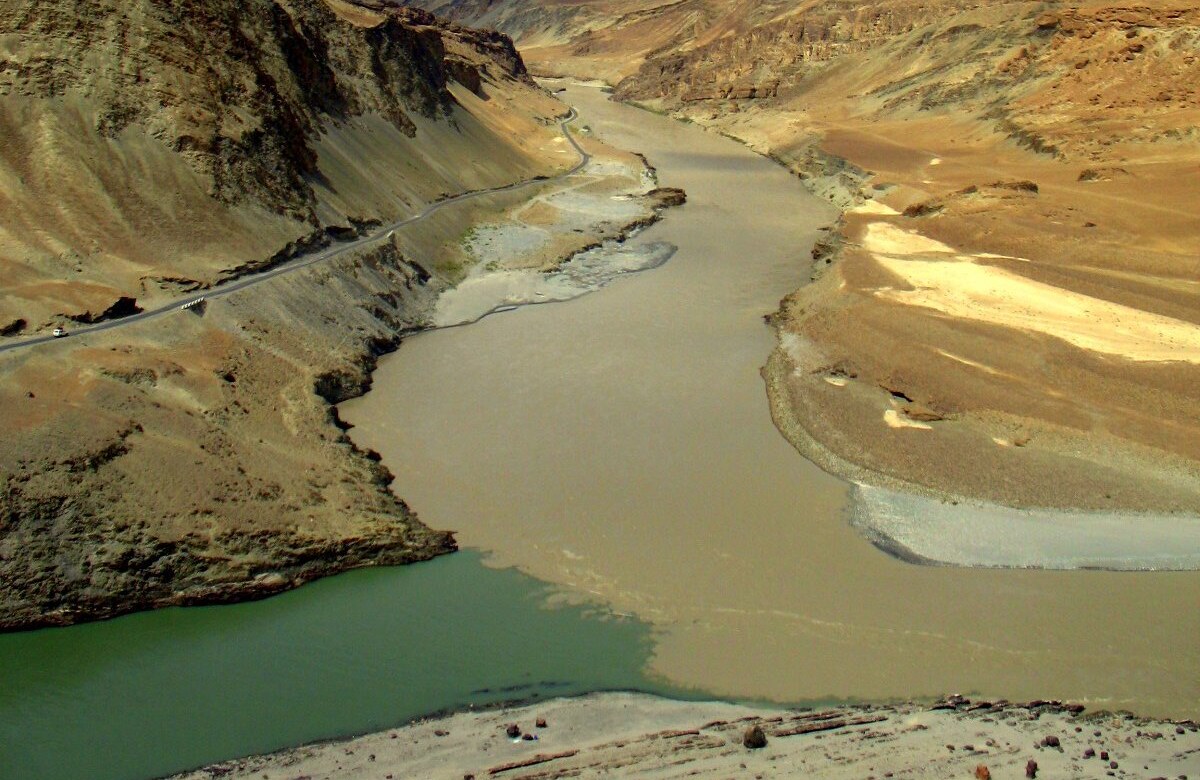
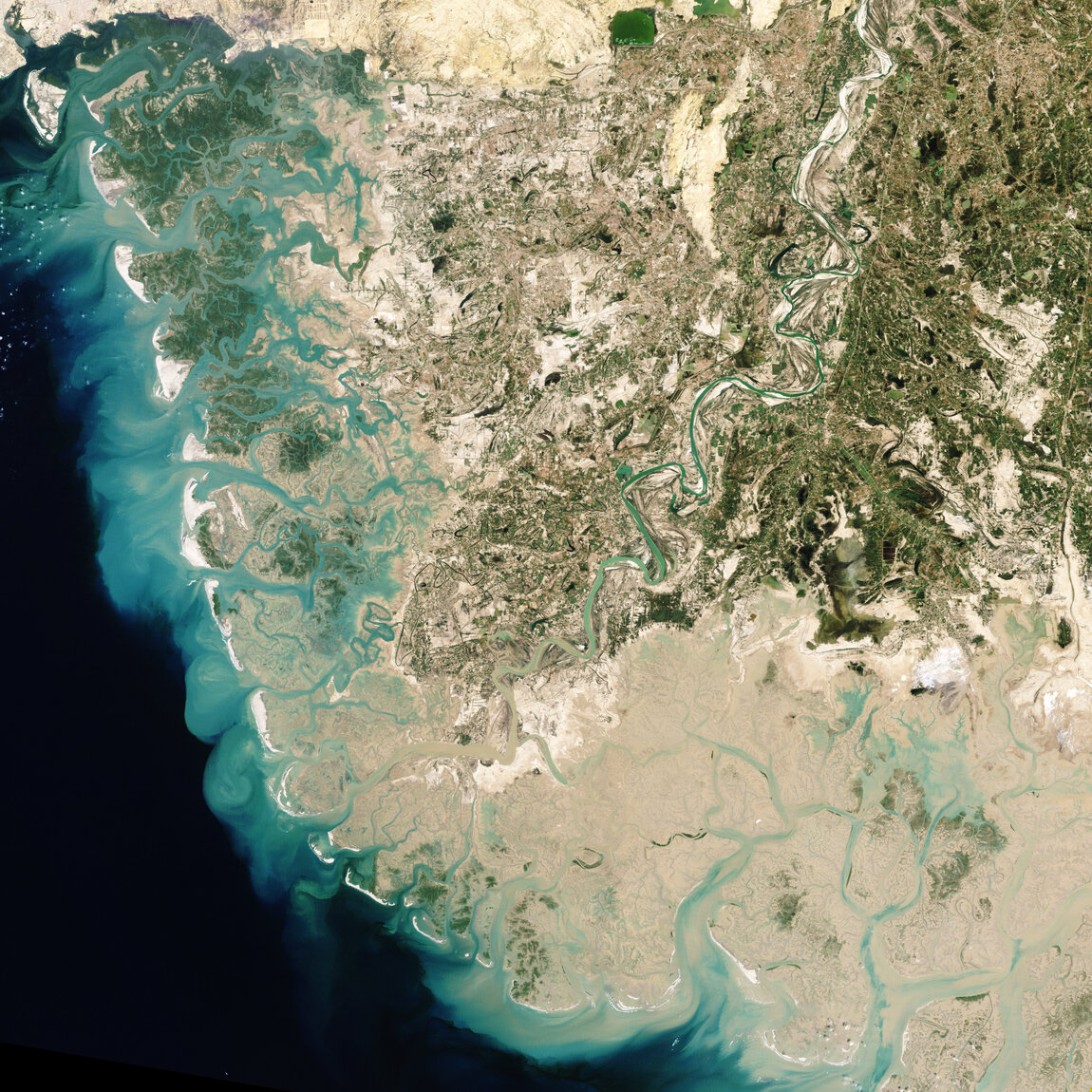
Image credit: Indus–Zanskar confluence in Ladakh, photographed by Payal Vora / Wikimedia Commons, CC BY 2.0, cropped. The cover depicts the river system; it is not a photograph of Ratle or Kishenganga.

Go to the source.
- Indus Waters Treaty 1960
- World Bank: resumption of parallel processes, 6 April 2022
- India: Foreign Secretary’s statement, 8 May 2025
- India’s UN statement, 23 May 2025
- Vienna Convention on the Law of Treaties
- ILC Articles on State Responsibility
- Award on Treaty Status, 31 August 2026
- Ratle interim measures order, 31 August 2026
- Neutral Expert competence press release, 20 January 2025
- Supplemental competence award, 27 June 2025
- Court competence press release, 6 July 2023
- Pakistan’s submissions, June 2025
- ILC work on armed conflicts and treaties