

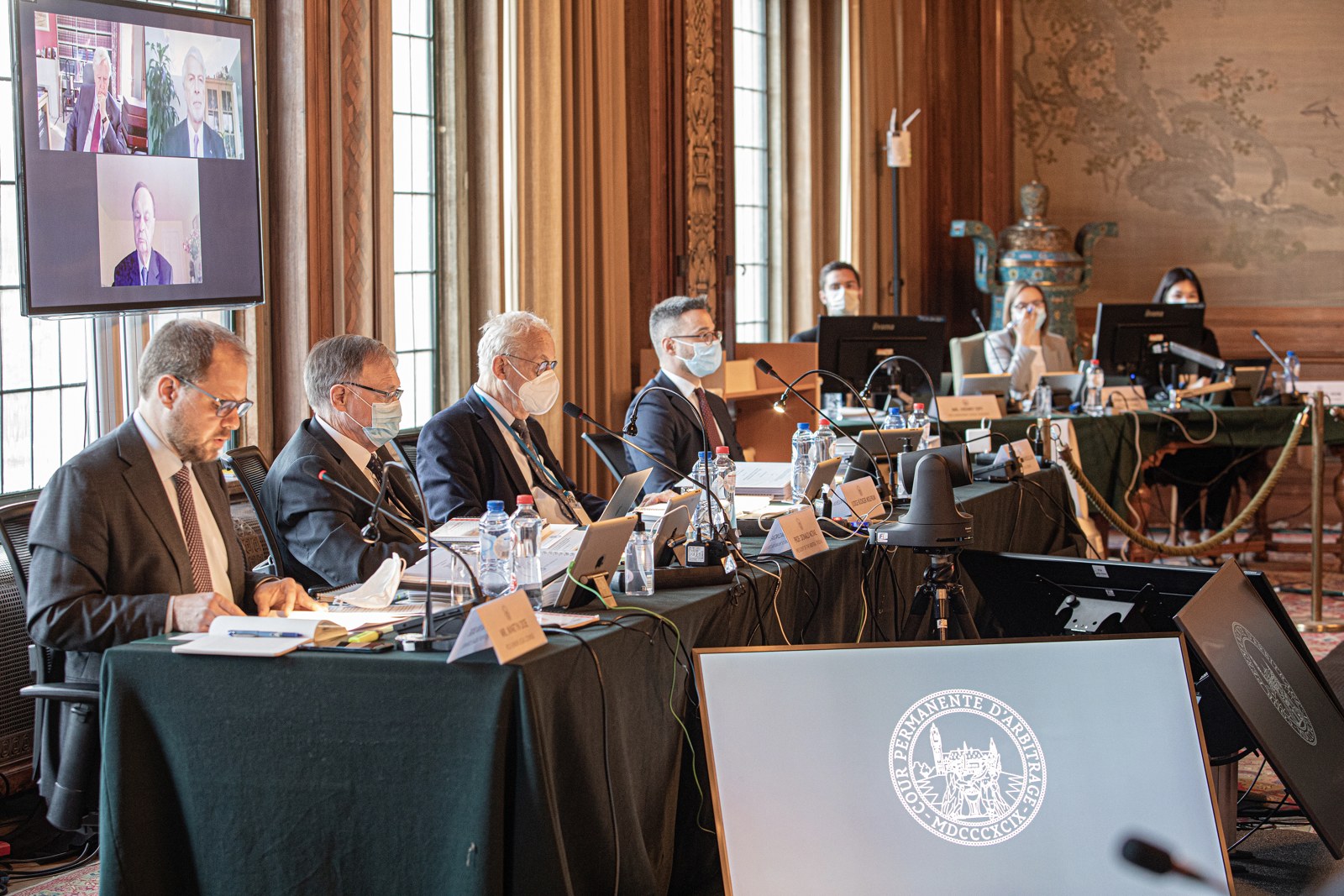
Eight years after Russian authorities detained three Ukrainian naval vessels and their crews near the Kerch Strait, the resulting international arbitration is approaching a hearing on the substance of the dispute. The tribunal has scheduled its merits hearing for 30 November and 1 December 2026 at the Peace Palace in The Hague.
The Permanent Court of Arbitration announced the arrangements on 12 November. The parties’ opening statements will be open to the public and livestreamed on the PCA website. That does not mean every part of the hearing will be public, and the scheduled hearing is not itself a final decision.
The incident behind the case
The dispute concerns the Berdyansk, Nikopol and Yani Kapu and 24 Ukrainian naval personnel detained following events near the Kerch Strait on 25 November 2018. Ukraine said the vessels were travelling from Odesa towards Berdyansk through the strait. Russian authorities arrested and detained the vessels and personnel for alleged violations of Russian criminal law.
The legal controversy concerns the protections applicable to naval vessels and their crews, and the lawfulness of the measures taken against them. Ukraine challenges the detention under the United Nations Convention on the Law of the Sea, usually known as UNCLOS. The parties disagree about the legal character of the events and the consequences that follow.
This is an inter-State arbitration: Ukraine is the claimant and the Russian Federation is the respondent. It is not an investor–State case, and the upcoming hearing should not be presented as a determination of every dispute between the two countries.
How the dispute reached arbitration
On 1 April 2019, Ukraine served its Notification and Statement of Claim on Russia, initiating proceedings under Annex VII to UNCLOS. Annex VII provides a framework for arbitration of disputes under the Convention. The PCA acts as registry, providing administrative support to the tribunal.
That institutional distinction matters. The case is decided by the arbitral tribunal constituted for the dispute; the PCA’s role as registry does not turn the proceeding into a judgment delivered by a standing bench of PCA judges.
According to the current official case record, the tribunal comprises President Gudmundur Eiriksson, Sir Christopher Greenwood, James Kateka, Kathy-Ann Brown and Alberto Székely y Sánchez. The membership has changed during the proceedings, so earlier reports and photographs may show a different composition.
The separate ITLOS proceedings
Ukraine also sought urgent protection from the International Tribunal for the Law of the Sea, or ITLOS. This was a provisional-measures proceeding: a request for interim measures while the main dispute awaited determination.
On 25 May 2019, ITLOS ordered Russia to release the three vessels and return them to Ukraine’s custody, and to release the 24 detained servicemen and allow their return to Ukraine. It also directed both States to refrain from action that might aggravate or extend the dispute. The relevant directions were adopted by 19 votes to one.
The order was legally significant, but it did not decide the merits of the Annex VII arbitration. Interim protection and final responsibility are different stages. A provisional-measures order should neither be dismissed as merely procedural nor described as a final victory on all the underlying claims.
What the 2022 award did—and did not—decide
On 27 June 2022, the arbitral tribunal issued its award on Russia’s preliminary objections. Preliminary objections concern threshold questions about whether, and to what extent, a tribunal may adjudicate a dispute. They are distinct from deciding whether the claims ultimately succeed.
For a reader following the proceedings for the first time, this is the essential distinction: jurisdiction concerns the tribunal’s authority to hear claims; the merits concern the legal and factual assessment of claims falling within that authority. The existence of a jurisdictional award does not allow either side’s allegations to be treated as established findings on the merits.
The present hearing is therefore a further stage in an existing case, rather than the opening of a new arbitration. Equally, describing it as a merits hearing does not establish in advance what findings the tribunal will make.
The route to the November hearing
- 25 November 2018: The incident involving the three vessels and 24 naval personnel takes place.
- 1 April 2019: Ukraine serves its notification commencing the Annex VII arbitration.
- 25 May 2019: ITLOS orders provisional measures requiring release.
- 27 June 2022: The arbitral tribunal issues its preliminary-objections award.
- 29 July 2025: The tribunal issues a decision addressing objections to its constitution, as announced by the PCA on 6 August 2025.
- 12 November 2026: The PCA announces the merits-hearing arrangements.
- 30 November–1 December 2026: The scheduled merits hearing takes place in The Hague.
The PCA reports that the written phase has been completed. The parties have submitted pleadings and supporting material, including witness statements, expert reports, factual exhibits and legal authorities. The oral hearing gives the tribunal a further opportunity to hear the parties’ arguments against that written record.
What readers can watch
The public-access announcement specifically covers the opening statements. Readers should consult the official case page and PCA website for the livestream and any updated arrangements. The notice does not promise publication of a final award immediately after the hearing.
Opening statements can clarify how each State now frames the dispute, which earlier findings it relies on and what relief it seeks. They remain submissions by the parties. Statements made at the hearing should be attributed accordingly until the tribunal makes its own findings.
Why the next stage matters
The case illustrates how an international maritime dispute can move through several institutions and procedural stages before a final merits decision. An urgent release order, a preliminary-objections award and a substantive hearing each perform a different function.
The immediate development is concrete: dates have been fixed, the written phase has concluded, and the public will be able to follow the opening statements. The outcome remains for the tribunal to determine. Careful reporting of the hearing will require distinguishing the parties’ arguments from the tribunal’s conclusions, and the announcement of a hearing from the delivery of an award.
Position checked on 23 November 2026. The photograph shows an earlier hearing in this arbitration in October 2021; it does not depict the forthcoming merits hearing.