Since the beginning of your career, you have worked at the intersection of technology and arbitration. How has this exposure shaped your thinking about transparency and the role of technology in dispute resolution?
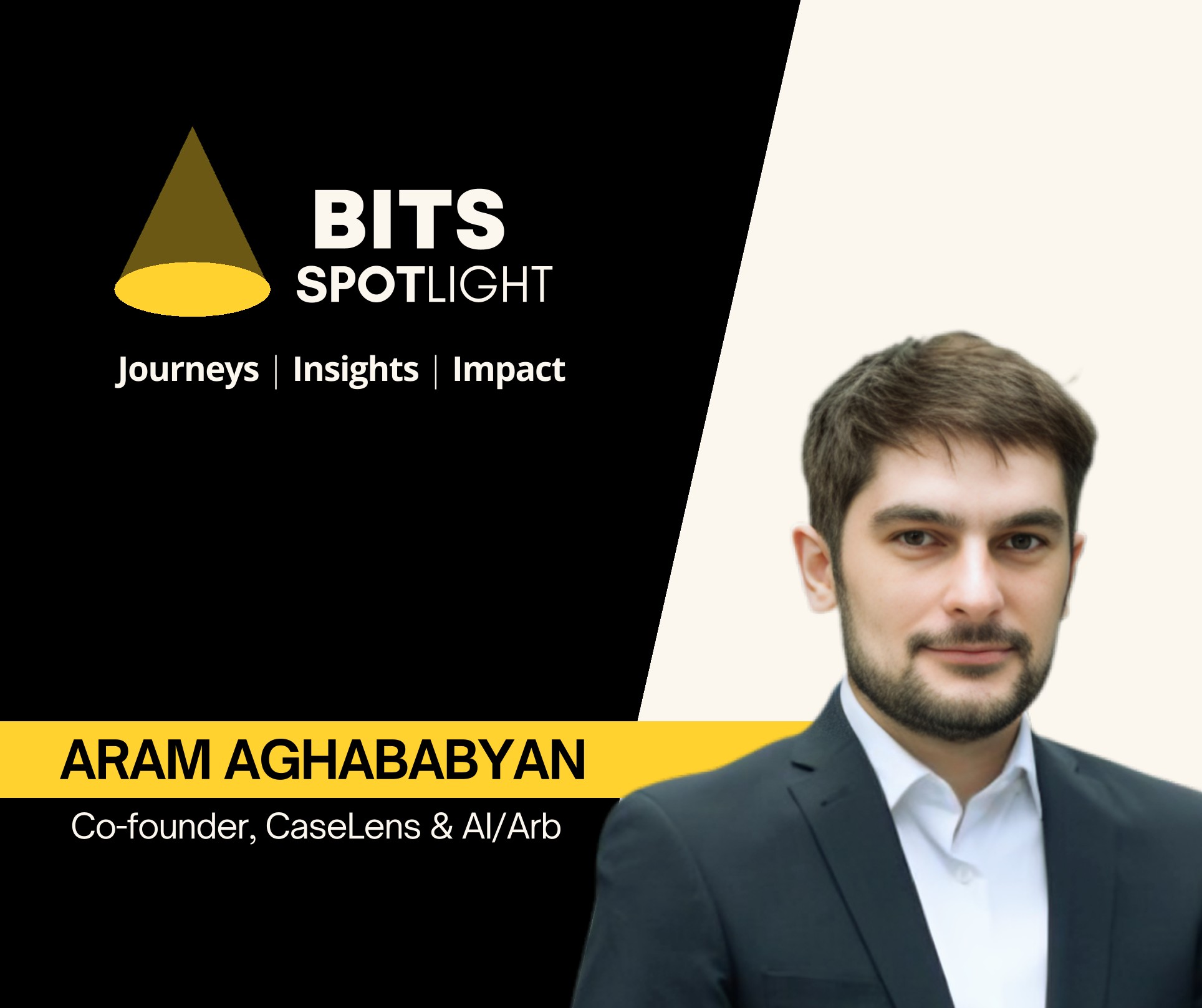
ARAM AGHABABYAN
Before co-founding CaseLens, I worked with three legal tech startups. Early in my career, I realized that breaking into the disputes market is challenging, especially coming from another country. Instead of pursuing traditional paths like internships or traineeship roles at arbitration centers and law firms, I recognized that my unique advantage was my technical skill set. I hold a Bachelor of Science in Statistics and have already spent about five years working as a project manager in tech companies.
Rather than viewing my non-legal background as a weakness, I saw it as a strength, given that many lawyers lacked technical expertise. Working at those startups quickly showed me that combining technical skills with an understanding of international arbitration is rare, and exactly where I could excel.
This experience also shaped my thinking about transparency: I saw firsthand how technology could make access to case information, document management, and dispute data more open and structured compared to traditional, fragmented methods.
You have successfully co-founded CaseLens, an AI-powered startup. How do you envision Natural Language Processing (NLP) and Large Language Models (LLMs) transforming legal casework, particularly in arbitration? Are there any limitations you are currently addressing?
ARAM AGHABABYAN
Before GPT-3 came into existence, I worked at an AI startup building a customer-support NLP chatbot. The best we could do was classic machine learning: label tons of examples so the bot could classify a user’s question and trigger a rule-based reply. It required huge effort and still broke whenever real people wrote something slightly different.
Today, LLMs have flipped that on its head. They can expand, summarize, transform, and even infer straight out of the box—no extra data or labeling needed. In law, where roughly 60% of the work is pure text, that unlocks possibilities we couldn’t have imagined just a few years ago.
In arbitration, this means AI can finally assist with preparing case chronologies, conducting autonomous document review, and building summaries of arguments without requiring months of manual work. One limitation we are actively addressing is ensuring that these outputs are highly accurate and achieve superhuman precision for serious use in proceedings.
CaseLens collaborated with the FDI Moot, 2024, and provided participants with an AI-generated timeline and semantic search capabilities. How was this collaboration initiated, and what feedback did you receive from the students and coaches who used it?
ARAM AGHABABYAN
The collaboration with the FDI Moot, particularly with Christian Campbell, began as they were among the earliest supporters who believed in our vision at CaseLens. Through this partnership, we provided two key features—AI-generated case chronologies and semantic document search—to participants from over 160 universities. The goal was to help students better understand the FDI Moot problem and enhance their preparation.
To ensure the platform genuinely supported students during their research and preparation, we organized approximately 20 feedback sessions. These interactions allowed us to adapt and improve CaseLens based directly on student needs and suggestions.
The feedback we received was overwhelmingly positive. Usage metrics highlight the platform's value: students logged in approximately 10,000 times and performed over 3,000 semantic searches per month. Many participants found it so beneficial that they requested similar support for other moot competitions like Vis and Jessup.
In your personal opinion, how do you think tools like CaseLens might transform the way legal professionals prepare for disputes? Do you see this as the beginning of a major shift in legal practice?
ARAM AGHABABYAN
Lawyers aren't going anywhere—but the way they work definitely is. Tools like CaseLens aren't about replacing legal professionals; they're about giving lawyers an unfair advantage. Imagine preparing for disputes in hours, not months, with pinpoint accuracy at a fraction of the cost. We're witnessing the beginning of a major shift. Those who embrace AI early won't just stay relevant—they'll set the new standard. The practice of law is becoming faster, more efficient, and more competitive. Lawyers and firms that recognize this shift early and invest in these technologies will be the ones shaping the future of the profession.
As the Co-Founder of AI/Arb, you play a pivotal role in AI within dispute resolution. What types of disputes do you believe are most suitable for AI integration today? How do you expect this landscape to evolve over the next decade?
ARAM AGHABABYAN
At AI/Arb, we explore how AI can make arbitration practice faster, more accurate, and less reliant on manual work. Rather than changing who practices law, AI is changing how legal work gets done—giving lawyers capabilities that would have been unimaginable just a few years ago.
While much has been said about AI arbitrators, I don't believe AI will replace decision-making in arbitration anytime soon. Not because the technology isn’t capable—it is—but because regulatory roadblocks and ethical concerns must be addressed before AI can take on that role.
Where AI will have the greatest impact is in how we manage dispute preparation. Tasks that once required endless copy-pasting, constant attention, and manual effort are already becoming easier. Over time, even more labor-intensive work will be automated end-to-end.
Large Language Models (LLMs) are incredibly powerful. AI systems built on them don’t need coffee breaks or weekends—they can process millions of documents with consistent precision, at just a fraction of the traditional cost. This will be the main economic driver behind the shift.
Drawing from your product management experience at several organisations, what unique challenges have you encountered while designing legal tech tools for lawyers and arbitrators? How does your approach to user-centric design adapt to these specialised needs?
ARAM AGHABABYAN
The right product design is what truly makes the difference—and I’m not talking about colors or visual appeal. Good product design means solving real problems for lawyers through functional, purposeful solutions.
When building tools for arbitrators and arbitration practitioners, it’s crucial to deeply understand their daily practice: what they do, what tools they currently use, and where those tools fall short. Solutions must be tailored to their specific workflows and pain points. Simply building yet another second-rate chatbot won’t move the needle.
The best way to empathize with lawyers is by applying design thinking principles—constantly gathering feedback during the design and building process to uncover the full range of opportunities AI can offer in their day-to-day work.
Your work spans both common law and civil law perspectives on arbitration. How do you address jurisdictional diversity when developing AI tools intended for global dispute resolution?
ARAM AGHABABYAN
In my experience, the key to addressing jurisdictional diversity is flexibility. Common law and civil law systems handle document production very differently—one expects broad disclosure, the other is far more limited.
Instead of building rigid tools, we focus on flexible AI workflows that can adapt to either approach. Our goal is to assist with understanding the facts of a dispute, without forcing users into a one-size-fits-all model. Respecting procedural differences is essential if you want to build tools that work globally.
In your role as COO at Superbot, you have managed operational scalability for data services. How has this experience influenced your approach to legal tech ventures where data privacy and precision are non-negotiable?
ARAM AGHABABYAN
Data privacy and protection are essential when building tools for international arbitration, where sensitive commercial information is often at stake. It is important to understand how AI solutions manage data confidentiality, not only in how models operate, but in how data is stored, transmitted, and protected at the infrastructure level. There is work to be done on both sides: technology providers must prioritize secure system design, while legal professionals must better understand cloud storage, computing risks, and data residency considerations. Strengthening this mutual understanding is critical to building trustworthy legal tech solutions.
You have successfully bridged legal content creation and technical product development. What strategies have proven most effective for fostering collaboration between the two? Are there specific practices you find invaluable?
ARAM AGHABABYAN
Because of the advancements in LLMs, writing content has become easier than truly reading and processing information. What matters now is packing insights into as few words as possible.
In the products we develop, we aim to use minimal wording to make information easy to read and navigate. This approach is something I carried over from my experience creating content for the legal industry, where clarity and brevity are critical.
You have balanced leadership with innovation throughout your career from Apello Software to Hoory and to co-founding a legal AI startup. What guidance would you offer to emerging professionals hoping to make their mark in legal tech and arbitration?
ARAM AGHABABYAN
If you're interested in tech and arbitration, you're focusing on the right space. A lot of work today revolves around publishing guidelines and discussing the role of AI in arbitration. But meaningful change won't happen through discussions alone. It needs people with a real understanding of international arbitration to roll up their sleeves and start building tools that genuinely support the demanding and complex work dispute lawyers face every day.
Interview by Saudamini Amare and Alifiya Olia for Arbitration BITS. Originally published on 2 May 2025. The Q&A follows the original interview, with formatting and typographic corrections for web readability.
Original LinkedIn publication